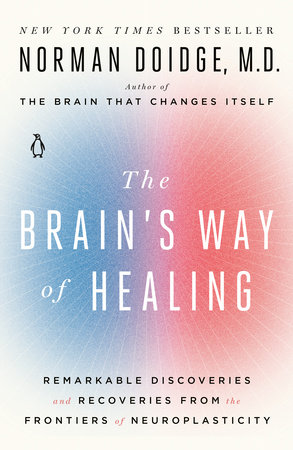
Reading notes on The Brain’s Way of Healing
Norman Doidge
During no-fins freediving training, I started thinking about the momentum of my own movement habits.
Pull, recover the legs, kick, then glide. After enough repetitions, the body often carries out the sequence on its own. I began paying attention to what happens after propulsion ends: as my body keeps moving forward, am I carrying unnecessary effort into the glide?
I noticed my habitual forward tilt of the pelvis and wanted to let it relax during the glide. For now, I would give my full attention to this one thing and feel what was happening there.
The sections on Feldenkrais in The Brain’s Way of Healing brought me back to this experience.
How the body learns again
Norman Doidge is a psychiatrist and psychoanalyst. In this book, he explores neuroplasticity, the brain’s ability to change its structure and function through activity and experience, and asks how it might contribute to recovery after injury or illness.
He follows people living with chronic pain, Parkinson’s disease, brain injuries, and learning difficulties. Through their stories, he introduces approaches involving movement, sound, light, and other forms of sensory input, discussing how they may affect the brain. Each case has its own circumstances; the improvements described cannot simply be assumed to apply to everyone.
I was especially interested in the discussion of feedback from the body. When I think about movement, I tend to imagine the brain issuing a command and the body carrying it out. But sensations are also travelling back from the body. Learning happens through that exchange.
The Feldenkrais Method helped me picture this process more clearly. Moving slowly and gently, and noticing how different ways of moving feel, gives me a chance to become familiar with an action all over again. Using less effort may reveal details that were previously obscured. A way of moving can become so familiar that I stop noticing how I am exerting myself.
This is where I began connecting the book with no-fins training. Even once I can perform a movement, there is still plenty to feel. I might swim the same distance repeatedly while my body follows the same pattern each time. Noticing differences helps me understand what I have been repeating.
During the glide, just the pelvis
The glide gives me a brief stretch of time to notice these details. Propulsion has ended, and I want to feel whether tension remains around my pelvis, and how that sense of forward tilt carries on.
If I think about streamlining, head position, and the timing of my arm pull and leg recovery all at once, my attention quickly scatters. So this time, I focus only on my pelvis. I keep the rest of the session as planned, leave my attention here, and try to let go a little.
Still, trying to relax can lead me to exert myself again. To put my pelvis into what I imagine is the correct position, I might tighten my abdomen, buttocks, or lower back. In my mind, I have made the adjustment; my body may feel no easier. I want to notice whether I am rushing to correct myself again.
My pelvis moves as part of the rest of my body. When I use a little less effort there, I also want to feel how other parts respond. Sometimes the difference is small and difficult to describe, so I can leave it undecided for a while. Sensation alone does not tell me my pelvis’s exact position, and I do not yet know how these experiments affect drag or performance.
In training, the Feldenkrais approach encourages me to spend a little longer with a familiar movement. I can give one detail my full attention, notice how the habit continues, and see whether there is room to release it.
This makes me think about effort in everyday life, too: how often something has already passed, while I am still holding on. In a familiar situation, my body tenses and a reaction follows before I have time to notice how the present differs from the past. Habits save me a great deal of thought. Sometimes they also make me repeat myself too quickly.
In the water, this becomes quite specific. I can bring my attention to my pelvis and try to feel that small effort. Habits elsewhere in life are often harder to locate. Perhaps I can begin with a moment when I do notice one, and take a little time before continuing as usual.
What interests me about neuroplasticity is that people can keep learning. There are still things to explore in the self I know so well. I have practised no-fins many times, yet a glide can still bring my attention back to my pelvis. It is a small discovery, enough to make me want to keep feeling what happens as I repeat the movement.
On the next glide, I want to stay with this. Once propulsion ends, I will try to let that small effort end too, and feel how my body keeps moving forward.